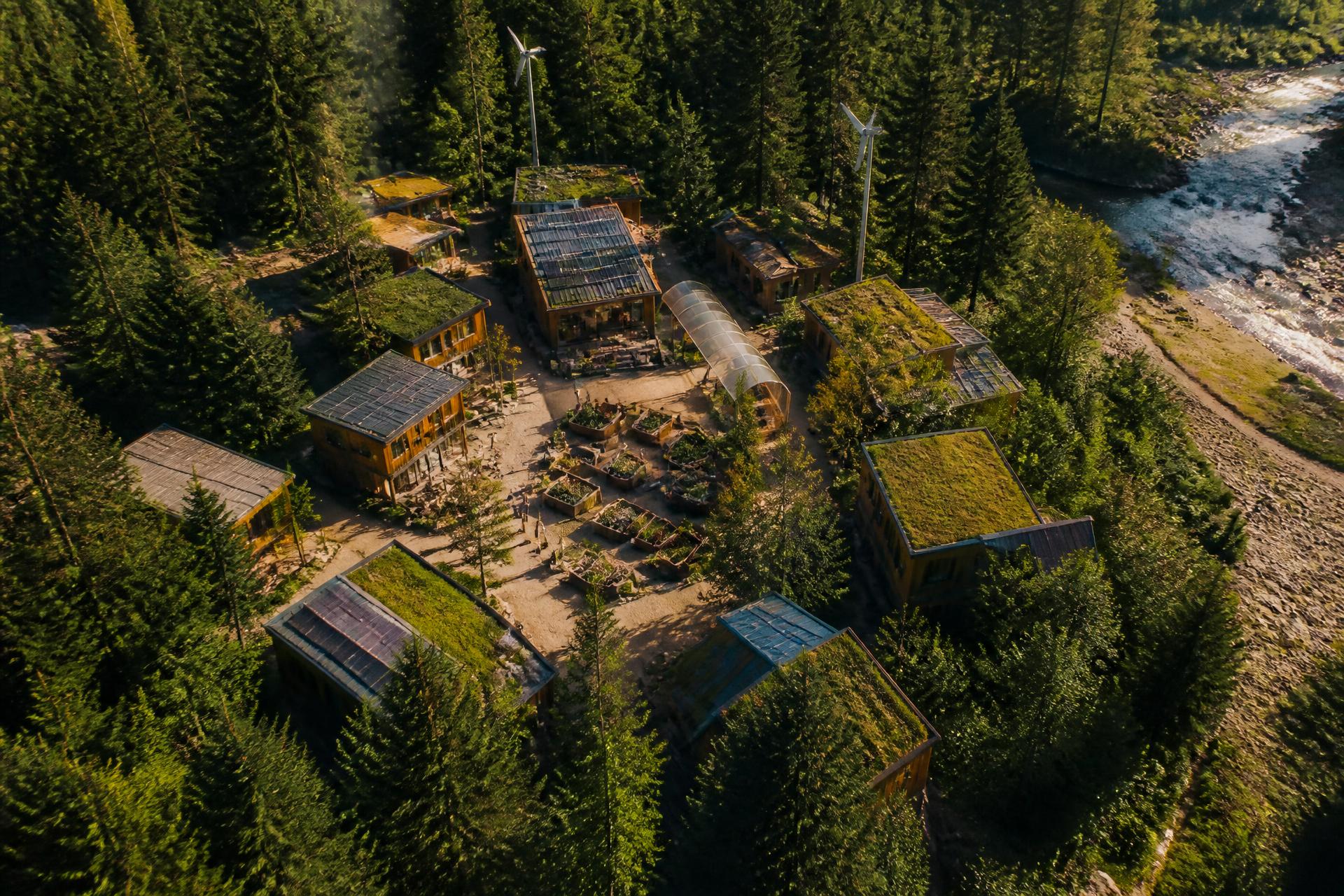
Aerial view of a small settlement of low green-roofed dwellings nestled along a river in old-growth forest at golden hour

Issue No. 01 · The solutions for tomorrow already exist today.

Designed by Nature.Built for Life.

A new generation of communities inspired by how living systems actually work, where ecological health and human wellbeing grow together.

The Idea

Remembering how life works.

For most of human history, our lives were shaped by the ecosystems around us. We knew the seasons, the watershed that fed us, the soil under our feet. Somewhere along the way we started designing our lives around efficiency instead of relationship, and quietly forgot that we were ever part of a living system at all.

The interesting question now isn't how much more we can extract from a place. It's what kind of life a place actually wants to support, and how we might live inside that answer rather than against it. Every landscape has a carrying capacity. A rainforest carries one kind of settlement, a dry valley another, a coastline another. Belonging to a place begins with listening to what the place is already telling you.

Technology has a role to play, and it isn't the one most people picture. It doesn't have to replace nature. It can help us understand it. Sensors that listen to a forest, models that track a watershed before shortages arrive, distributed energy that lets a small town run on what the sun and wind give it. Used well, technology becomes a translator between us and the living world.

Ecologists have a word for a species whose presence makes a whole system healthier. A keystone species. Beavers, wolves, oysters, elephants. Humans can be that too. We spent a long time acting like the exception to every rule of life. We can just as easily be the part of the system that returns more than it takes.

We don't need to invent the future. We need to remember how life works, and use today's tools to live in step with it.
Four Pillars

What a town closes its loops on.

Nature doesn't run supply chains. It runs cycles. When food, water, power, and people come back to a place, the place starts to mend. The people do too.

01 · Food

Raised Here

A town that feeds itself begins with the soil under it. When land is treated as something that gives back what it receives, most of what people eat can come from nearby. Food stops being a supply line from somewhere else and becomes a relationship with the place you live in.

02 · Water

Restored & Valued

Water is a flow you join, not a resource you import. Catch the rain, recharge the aquifer, cycle the greywater, and a community can live inside the water cycle instead of piercing it. Old civilizations understood this. Modern sensors just help us do it with more care.

03 · Energy

Captured for Sovereignty

Energy independence is its own kind of metabolism. Solar microgrids, a little wind, shared battery storage, and a town can make what it uses, keep what it gathers, and share the rest. Nothing pulled from far away. Nothing that breaks when a wire across the country goes down.

04 · Community

Woven Together

The social fabric is the part most people forget to count. Belonging, reciprocity, shared decisions, knowledge passed between generations. These are what hold every other system together. A town can feed and power itself and still come apart if no one knows their neighbors.

Ancient Wisdom. Modern Tools.

Old knowing. New capability.

Living systems have always known how to repair themselves, and people used to know how to take part in that work. What's different now is that we can do both at once, with the science and the tools to match.

Ancient

What the living past knew

A town lives inside an ecosystem, not on top of one.

Water, soil, and the turning of the seasons are partners in the work.

What you take, you give back. That's how abundance lasts.

Scale matters. Every place has a carrying capacity.

The bonds between people are the immune system of a place.

Modern

What we can do now

Solar microgrids and shared battery storage.

Regenerative farming guided by soil biology, not guesswork.

Quiet sensors listening to forests and watersheds so we can respond before they falter.

Open knowledge networks for designing communities as living systems.

Work that travels with you, so you can choose the land instead of the commute.

The Shift

The numbers are moving too.

For the first time in decades, more people are choosing smaller. The data below comes from U.S. census research, European demographic studies, and migration economists tracking a shift that started before the pandemic and accelerated sharply after it.

670,000

People who moved into rural U.S. counties, 2021 to 2024

The decade before COVID saw a net loss of 100,000 from those same counties. The reversal is the largest on record.

Highest in a century

Rate of young adult in-migration to small towns

Americans aged 25 to 44 are moving to small towns and rural areas at the highest rate since the early 1900s, according to the University of Virginia's Cooper Center.

14 to 23 million

Americans estimated to be relocating because of remote work

Cost of living, proximity to nature, and community quality are the top reasons cited. City salaries, rural land.

5 countries

Where researchers documented measurable urban-to-rural migration post-pandemic

Spain, Sweden, Great Britain, Japan, and Australia all recorded net movement away from capital cities into smaller towns between 2020 and 2022.

Sources: USDA Economic Research Service, UVA Cooper Center, Harvard Joint Center for Housing Studies, PMC Rural Revival Study, Australian Government Infrastructure Report.

Join the Current

The future is being grown in small towns.Be part of it.

One letter a month. Stories from towns quietly figuring this out, and the people, tools, and ideas behind the work of living in right relationship with a place.